07021 The Architecture of Community
Lovers must not, like usurers, live for themselves alone. They must finally turn from their gaze at one another back toward the community. If they had only themselves to consider, lovers would not need to marry, but they must think of others and of other things. They say their vows to the community as much as to one another, and the community gathers around them to hear and to wish them well, on their behalf and its own. It gathers around them because it understands how necessary, how joyful, and how fearful this joining is. These lovers, pledging themselves to one another “until death,” are giving themselves away, and they are joined by this as no law or contract could join them. Lovers, then, “die” into their union with one another as a soul “dies” into its union with God. And so here, at the very heart of community life, we find not something to sell as in the public market but this momentous giving. If the community cannot protect this giving, it can protect nothing. — Wendell Berry, Sex, Economy, Freedom, and Community
Community is a mixture of both spontaneous and directed order.
Some interesting work on the actual practicalities of organizing structures comes from permaculture thinker and resilience expert Vinay Gupta. The rest of this document derives from his analysis, which can be read in his original presentation online at ipermie.net — Dealing in Security
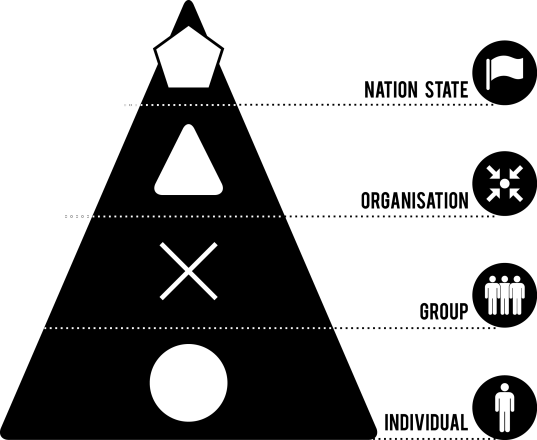
Levels of Cooperation
Vinay counts four levels of cooperation. Each level has its own characteristics and requirements for infrastructure. Each depends upon the levels or tiers that it rests upon.
Individual/family
The fundamental units of all societies are individuals and their biological or adoptive families or households.
Groups
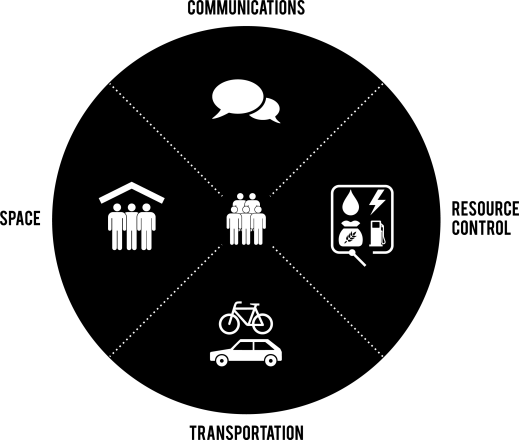
People and families or households form groups to achieve mutual purposes. Each group requires:
- Communications
- Space
- Boundaries
- Transportation
Boundaries may be literal as in fences or geographies or they may exist in the realm of ideas and invisible structures. To be a group involves common identification together with an understanding that there are those who are not in the group. This creates boundary conditions. Boundaries and edges are fertile places for action and development.
Groups may not have any leadership. Many people, for example, identify with an ethnic or racial group. But there are no recognized governments of races. We don’t find a “governor” of the white people group nor a president for the people of African descent group. Leaderless groups are a common aspect of invisible structures.
Organizations
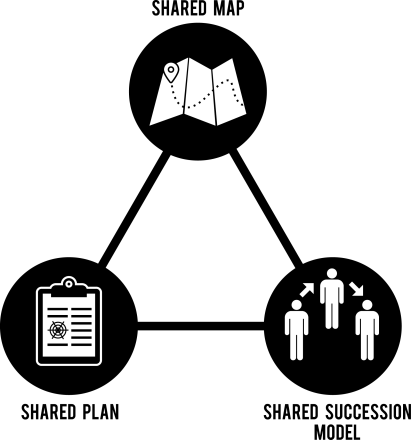
Organizations are complex forms of groups with purposes and goals that are more than the simple sum of the purposes of its members. All organizations are groups — all groups are not organizations. Besides the four common requirements of groups, organizations need:
- a shared Map
- a shared Plan
- a shared Plan of Succession
Organizations are more structured than simple groups. They will have written rules for their governance and an identified leadership group and/or methods of leadership and decision-making.
State
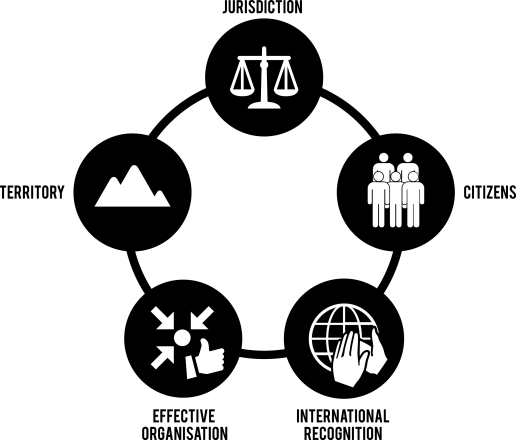
Vinay identifies the State as the fourth level of cooperation. A state has five requirements:
- Territory
- Jurisdiction
- Citizens
- Effective organizations
- International recognition
“Effective organizations” refers to systems and structures of governance — a civil service bureaucracy plus systems of protection and safety (police, fire, ambulance, military defense, etc.)
“Effective organizations” includes a system of civil society organizations that explicitly and implicitly supports the system of power and domination that characterizes a particular nation state. Among other purposes that could be cited, they give individuals and groups a sense of empowerment and engagement with the process of governance in their society. That may be real and effective or it may be faux and thus part of the domination system.
In our modern world, we don’t recognize a state that does not have a geographical territory as its base, where it exercises jurisdiction. That may not always be the case in the future.
Vinay’s work on these issues is in the context of resilience and disaster response. It is useful for our purposes too.
As we look with “permaculture eyes” at the present modern system of nation states, we can see many Type 1 errors. Nuclear bombs, subsidies of environmental destruction, and political criminality run rampant top that list. Alas for us all, nation states are among the most powerful structures driving ecological devastation and injustice in the modern world.
But there is much hope. A modern nation state cannot maintain its legitimacy without the support of civil society organizations and structures. It cannot govern effectively without those systems. The patterns established in the mid-level civil society organizations flow in a multitude of directions. They receive information and resources from grassroots groups, individuals, households, from lateral groups and organizations and from governance organizations. They send information and resources upwards to the realm of actual governance and laterally to other civil society organizations. Without their mediating services, states fail.
Permaculture —
- Starts at our doorsteps,
- Uses small and slow solutions,
- Prefers biological systems,
- Utilizes natural succession.
In most circumstances our interventions begin at the individual and household level. We combine into groups and then unite to form organizations, through which we can impact the modern nation state.
This is the way we change the State, one individual and family, one group and organization, at a time. It is slow and small and biological. It uses natural selection. It works.
How do we speed things up? We work harder and smarter to develop communities of support and structures of beauty, wisdom, and ecological sanity.
They fight with money. We resist with time. They will run out of money before we run out of time.