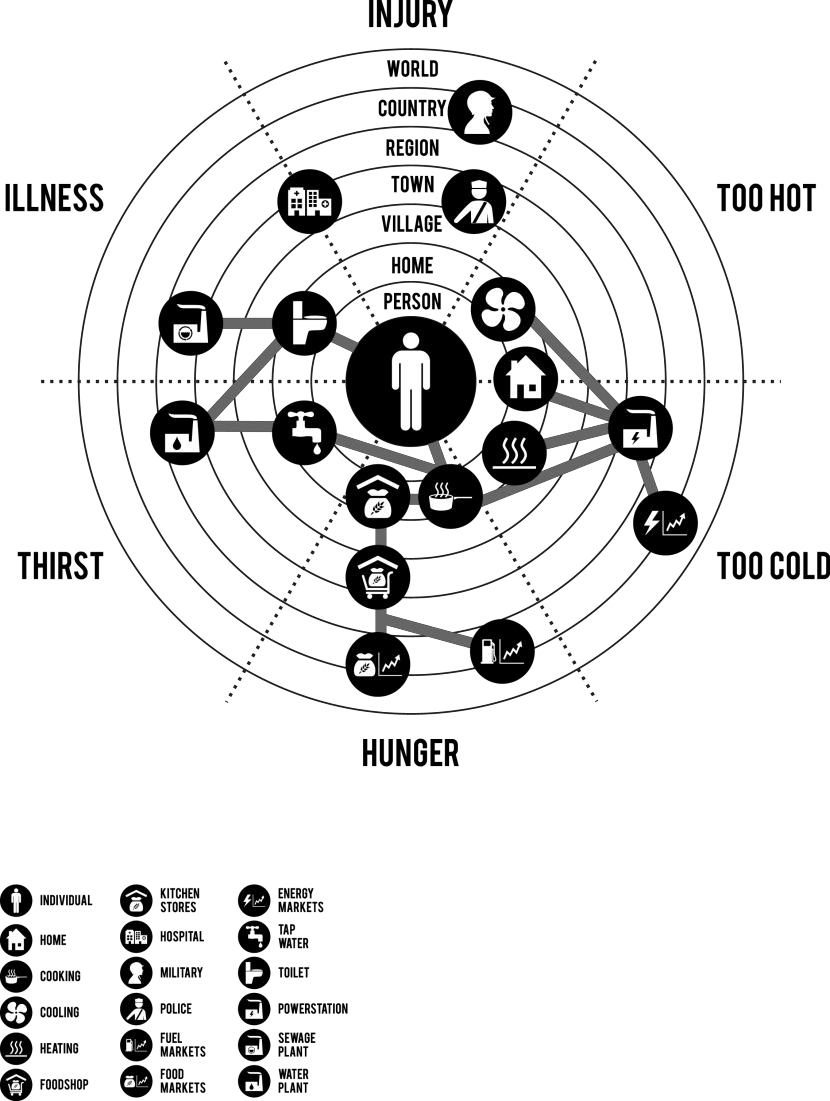
09071 Simple Critical Infrastructure Maps
Decentralized infrastructure… can take advantage of economies of agility. They are bought as needed rather than planned decades in advance, scaled to fit needs, can be upgraded piecemeal or moved and generally have much lower risk. Decentralized infrastructure is the wave of both the past and the future. Old decentralized systems were things like water mills and pit latrines — systems which ran directly from the natural world to provide basic services.
New decentralized infrastructure is systems like solar panels, local water purification (SODIS or SOPAS), advanced composting toilets, wind energy and so on… From an infrastructure mapping point of view, the critical distinction between centralized/decentralized systems is dependencies. Centralized systems typically have large and complex networks of requirements to operate, but operate at high efficiency. Whether the input is fuel or chlorine or spare parts, it seems that in general the cost of efficiency is complex dependencies and overall system brittleness. — Vinay Gupta, Mike Bennett, SCIM
The Simple Critical Infrastructure Maps system is a Creative Commons licensed mapping and analysis tool for evaluating personal and social persistence and resilience. It is intended to be used for planning, and is simple enough to learn during a crisis to facilitate cooperation and effective response
Developed by permaculture designer and polymath Vinay Gupta, it helps us understand our vital services and how they keep us safe. By creating a better understanding of our actual situation, we can develop ways to make our systems more persistent (resistant to failure) and resilient (able to recover after damage or disruption).
As a tool, it helps us understand the whole system at play in any given situation.
You can download the original document Dealing in Security at ipermie.net in English, or you can download it in English, Greek, or Spanish at http://www.resiliencemaps.org/ together with other graphics that illustrate its concepts.