03031 Peak Oil: Concepts and Consequences
In many OECD countries… oil consumption came to a peak and it is slowing down, but the growth of the demand is coming from China, the Middle East, India. So demand will grow. The question is, whether or not we will be able to increase the production to meet that demand growth. According to our projections in the World Energy Outlook, even if we were to assume, and this is very important, even if we were to assume the next 20 years global oil demand growth was flat, no growth at all, in order to compensate the decline in the existing fields we have to increase the production about 45m bpd just to stay where we are in 20 years, which means to find and develop 4 new Saudi Arabias, and this is a major challenge. — Fatih Birol, Chief Economist of the International Energy Agency
How long does it take the earth’s population to use one billion barrels of oil? Twelve days. Half of all the oil that has been used to date has been used since 1985.
I am one of the co-moderators and registered owner of runningonempty2@yahoogroups.com. This is a conversation with more than 7000 members which has been discussing peak oil and other energy issues since 2001.
Peak oil is a theory regarding oil production, developed and publicized by the late Dr. M. King Hubbert, who was a geoscientist. He worked for years at the Shell Oil Company laboratory in Houston. After retiring from that career, he became a senior research geophysicist for the United States Geological Survey. He taught geology and geophysics at Stanford University and the University of California at Berkeley. He developed a theory regarding oil production which predicted that for any given geographical area — from an individual oil field to the entire planet — the process of oil production can be described by a bell curve.
Using the science of his theory, Dr. Hubbert correctly predicted in 1955 that United States oil production would peak in 1970/71 and decline thereafter. At the time of this prediction and for years thereafter, people ridiculed him. Yet, as he predicted, US oil production continued to increase until 1970/71, at which time it “peaked.” US oil production has been generally in decline since then. US oil production in 2011 was 41% less than 1970 oil production.
You can view a chart showing US oil production from 1859 to 2011, which shows the peak and decline, at http://www.eia.gov/dnav/pet/hist/LeafHandler.ashx?n=PET&s=MCRFPUS2&f=A (retrieved on 2026–03-19, see below). It’s not an even smooth curve. It has little ups and downs. The trend over time is clear.
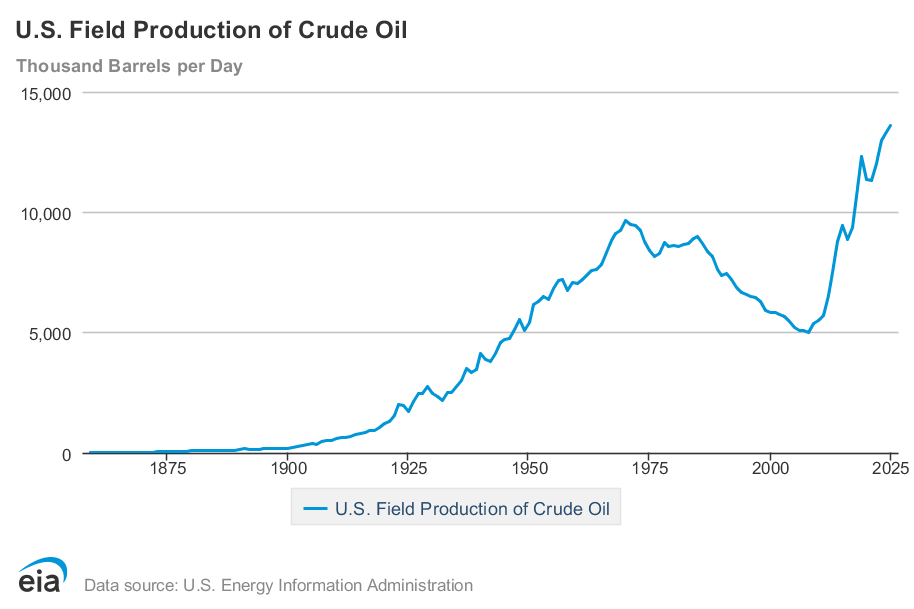
EIA graph of U.S. Field Production of Crude Oil in Thousands of Barrels per Day. (retrieved 2026–03–19)
Note from 2026: this whole section was written in 2011. At that time the shale oil boom had just begun. This is the second hump in the graph. The second hump is higher and its ascent steeper than the first one. Its decline will mirror its ascent, just like the first hump of the graph. Due to this seemingly new abundance of oil, the discussion on Peak Oil largely died down.
Discussion at sites like Our Finite World https://ourfiniteworld.com/ continued since the fundamentals did not change: crude oil is still a finite resource and will hit limits to extraction. Gail Tverberg and commentators argue the case that shale oil extraction peaked in 2025 and will decline rapidly in the coming years.
EROEI, Thermodynamics, Alternative Fuels
Petroleum is, without a doubt, the “Queen of Fuels.”
It has been cheap, versatile, and widely available for decades. Because of its versatility and cost relative to its production expense, it is essential to human society as we know it at this stage of our technological and social development.
Petroleum has a high energy returned on energy invested. We refer to this as EROEI. Working with this concept requires a brief review of the laws of thermodynamics.
- You can’t win.
- You can’t break even.
- You can’t get out of the game.
For our purposes, the important law is the second. Every time energy changes, you lose some of the original energy content. This is true without exception for all energy transactions. It’s why we say, “You can’t break even.” If you want 100 BTUs of work from a hydrogen fuel, you will have to spend more than 100 BTUs of some other fuel to get that potential 100 BTUs of hydrogen work.
Since there are no exceptions to this, it is true of fossil fuels.
Why are fossil fuels so important? They work so excellently for us because the original energy investment was ancient sunlight which millions of years ago fueled the growth of the plants and the creatures which ended up becoming coal, natural gas, and petroleum. Fossil fuels have a high EROEI in the present, because the original energy investment — sunlight — happened millions of years ago. The end result (gasoline in your tank) has less energy than the total energy investment in the product (from ancient sunlight through to the energy involved in its production and refining). That doesn’t matter because all we have to account for is the extraction and refining work on our end of the history.
Unfortunately for humanity, all substitute fuels like hydrogen or ethanol require the expenditure of the full energy investment up front. As that energy cycle turns, we discover that there isn’t any such thing as a free lunch with energy. Our alternatives to fossil fuels, without exception, have low EROEI. That doesn’t mean they don’t work. It does mean that they don’t do as much work for as little input as is the case with hydrocarbons.
We get less work for our effort with alternative fuels and our work costs more. That is an issue we will have to cope with during the coming decades.
A second issue is the decline of the EROEI of oil and gas production. In the early days of conventional oil production, we got 100 barrels of oil for every barrel of oil equivalent of energy invested in exploration and extraction.
As time passed, we found and began to pump all of the easy oil. In the beginning, oil actually flowed to the surface on its own. Early wells were shallow and tapped formations with so much pressure the oil blew through the drilling equipment creating “gushers.”
Now we willingly pay tens of millions of dollars to drill wells in the deep ocean and millions of dollars to drill for oil on dry land.
Of every 100 barrels of oil that we pull out of the ground —
- 10% of the energy is used to extract the oil.
- 27% is used to refine the oil into usable products.
- 42.5% is used to construct and maintain the transportation infrastructure necessary to move the oil around, and to actually move the oil around to where it needs to go.
So only 20.5% of the original energy value of the 100 barrels of oil is available for use at the end consumer stage.
Most of that 20.5% of our 100 barrels of oil energy ends up as fuel, and the internal combustion engine wastes most of the energy it burns as heat. That’s why your car has a radiator and a cooling system that you fill with antifreeze. According to Wikipedia, the average efficiency of internal combustion engines is 18–20%.
This means that only FOUR PERCENT of the original energy of the 100 barrels of fuel actually is used to move a vehicle. Or, for every 100 barrels of oil we pump, we get to use four for our personal use.
That’s not quite true though. What does the weight of a vehicle consist of? Mostly steel, rubber, plastic, etc. and the weight of the fuel itself. Less than TEN PERCENT of the weight moved by a typical vehicle is an actual human body.
So ultimately, the way we presently do things. NINETY-NINE POINT SIX PERCENT of the original energy endowment of that 100 barrels of oil is either consumed in its production of fuel, frittered away as heat, or used to move steel, plastic, etc. down the road. ONLY FOUR TENTHS OF ONE PERCENT moves people around.
That’s apparently the best that the world can do at this stage of its development. It’s embarrassing, though, to run the numbers like this, and discover how incredibly energy inefficient our transportation system is.
Price and Demand
The issue with peak oil is not that we are in imminent danger of running out of petroleum. We don’t anticipate a near-term situation where we produce no petroleum fuels because of absolute shortages of petroleum.
The problem is that demand is on track to outrun production. The market’s response will be price increases so that hydrocarbon products will become much more costly over time.
In the last few years, we’ve seen that economies worldwide are sensitive to the price of petroleum. High petroleum prices contribute to riots, government instabilities, and the loss of millions of jobs around the world. Since the peak of US oil production in 1970, we have participated in three major wars in or near the oil producing areas of the Middle East.
Looking for a cavalry to rescue us
Many of us visualize a high tech market driven cavalry coming to our rescue just in the nick of time. We plan to drive our hydrogen powered SUVs into the filling station of the future and gas up with hydrogen or charge our batteries with electricity. We have zero intentions to reduce the importance of the personal automobile to our lifestyles.
That may not be true of the younger generations. News seems to be bubbling up that many of today’s young people don’t care about owning and driving automobiles. They prefer to organize their lives so that they don’t need to drive a car. That’s a smart move for young people.
In 1998, two-thirds of potential drivers 19 years old and younger had driver’s licenses. In 2008, less than half of potential drivers had licenses. In 1985, young people ages 21 to 34 bought 38% of new vehicles. Now, this demographic group buys only 27% of new vehicles.
The Economic Fallacy About Oil
Economists seem to think that if the money is there, there will be no energy problem. They say that if a fuel becomes more scarce, the price will increase. As a result, people will use less and the market will look for substitute fuels. True enough, as far as it goes. What happens, however, if there are no substitute fuels of equal or greater EROEI to the peaked petroleum? Markets can only “find” what is there to be found, or what is scientifically possible to discover. Money can’t actually transform a sow’s ear into a silk purse.
A further problem with the economic cavalry to rescue us argument is that governments worldwide finagle energy prices. Some act to increase the price of some fuels. Others act in contrary purposes, attempting to drive down the price of fuels. This government meddling prevents markets from sending accurate signals about the relative scarcity of fuels.
Bad market information results in bad market prices which cause bad energy market decisions.
Saudi Arabia, for example, subsidizes all energy expenses in its Kingdom. As a result, Saudi Arabia uses energy with extreme inefficiency, even though in less than 20 years, if their current trends continue, their domestic consumption will increase so much that it will require all of the nation’s oil production leaving nothing for export.
We have a similar situation in the United States, where governments have finagled energy prices for decades. The entire 20th century construction effort created a built environment that uses energy with amazing inefficiency. The same is true of our transportation systems. We are built up and ready to go for a system based on cheap fossil fuels. Alas for us all, those days are gone.
To many economists, politicians, and the general public, the laws of thermodynamics are irrelevant before the power to the marketplace. This illustrates the serious danger of widespread scientific illiteracy.
Just the Production Facts
Since 2005, world oil production per day has floated between 84 and 87 Million Barrels per Day (hereafter “MBD”) of “petroleum” — except, as we shall see, this figure includes much more than simple crude oil production. One way that governments and industry are hiding the true facts about energy access is by finagling the statistics so the situation seems more positive than it actually is in reality.
Total World Oil Supply
Change in total World Oil Supply, as reported by the U.S. Department of Energy, 2005–2011: +3.2%
However, before we break out the champagne, let us examine the curious details.
Total World Oil Supply is not just actual oil. It also includes lease condensate, natural gas plant liquids, refinery processing gain, and other liquids. The “ other liquids” category is mostly corn ethanol. Yes, it’s true. The United States government is doctoring its reports on World Oil Supply by including corn ethanol and other non-oil products in its totals.
A second curious detail is that the natural gas plant liquids, refinery processing gain, corn ethanol, and lease condensate, do not have the energy intensity (“energy returned on energy invested”) of crude oil.
Remember that the next time someone brags about world oil production keeping up with demand. If we only look at actual crude oil production, we see a different story.
Actual crude oil production is that good old fashioned black stuff. It came oozing up out of the ground when old Jed Clampett shot at a deer and missed and thereby laid the groundwork for the hilarious Beverly Hillbillies television series. It is what most people think of when they see the words “oil production.”.
World Actual Crude Oil Production million barrels per day, not including corn ethanol, natural gas plant liquids, refinery processing gain, or lease condensate
Change in actual crude oil production, 2005–2011: +.67%
That’s less than two-thirds of one percent change in six years of intensive drilling worldwide.
Now let’s look at that category, “Other Liquids.”
How did corn ethanol production do? Between 2005 and 2011, it zoomed up by 187%.
That’s production. Now let’s look at consumption.
World Energy Consumption (million barrels per day)
Years 2005–2011 that world production exceeded consumption: 1
Years 2005–2011 that world consumption exceeded production: 6
Change in consumption, 2005–2011: +3.9%
Change in total oil-like liquids production (including corn ethanol), 2005–2011: +3.2%
Change in actual crude oil production, 2005–2011: + .67%
Production and consumption data reported as thousand barrels per day, from the Energy Information Agency of the US Department of Energy, at http://tinyurl.com/7u6pf83.
Oil is oil. Or is it?
Each barrel is about 44 gallons (166.56 liter).
There are two primary kinds of conventional petroleum: Light sweet crude and Heavy sour crude. The price of oil you see on the news is the price for light sweet crude. A 44-gallon barrel of light sweet crude will yield about 22 gallons of gasoline plus assorted other refined products.
But a 44-gallon barrel of heavy sour crude will yield much less gasoline. Refineries that process light sweet crude cannot process heavy sour crude.
The situation of reporting petroleum production is about as complicated as it gets. We’ve already seen that “total world oil production is not just world oil production.” It’s also various other liquids including corn ethanol.
So when reading petroleum production statistics, consult the fine print for the definition of the resources being reported. Dr. Colin Campbell, a retired petroleum geologist who was one of the authors of the 1998 paper that reminded the world of M. King Hubbert’s work and noted its implications for the present, says that there are nine different kinds of petroleum products that are sometimes lumped together into one set of production statistics, and sometimes broken out separately:
- Regular Conventional Oil and Gas
- Heavy Oil (<17.5 deg API — a measure of density)
- Bitumen (defined by viscosity)
- Oil Shale (immature source rock, from which oil can be extracted by heating)
- Shale Oil and Gas (that can be extracted by artificially fracturing reservoirs lacking adequate natural porosity and permeability)
- Deepwater oil and gas (>500m)
- Polar oil and gas
- Natural gas liquids from gas plants
- Non-conventional gases (coalbed methane, hydrates etc.)
Add in refinery processing gain and corn ethanol and you have even more confusing statistics to ponder.
Dr. Campbell wouldn’t add corn ethanol into this “total oil” mix. Doing so amounts to the politicization of oil statistics and that is worrisome since bad market information inevitably leads to bad market decisions which in turn sends bad market signals leading to even more bad market decisions. That is a vicious negative feedback loop which has already caused major problems and that will get worse going forward.
The evidence seems to be that world production of light sweet crude (the good stuff) has already peaked. The total change in actual crude oil world production is less than 1% for the past seven years.
Saudi Arabia says they can’t increase production of light sweet crude, but they can ramp up their production of heavy sour crude. They claim they can get to 12 MBD. However, the US Energy Information Agency (part of the Department of Energy) has been saying that by 2020, Saudi Arabian production must be at least 22 MBD to meet the expected world demand. Saudi production in 2009 was 8.25 million BPD, so there is a large shortfall between expectations and actual reality. Now the IEA is saying that Saudi production will fall in the future.
There is another minor devil in these expectations of a growing demand for Saudi oil exports. The government of Saudi Arabia heavily subsidizes energy so there is little incentive for conservation. It is thought that these subsidies are necessary to keep the population from revolting. Changing the domestic subsidy situation is fraught with peril for the Saudi aristocracy. If current trends continue, sometime between 2020 and 2030, Saudi Arabia will become an oil importer because of increases in its own domestic demand for fuels. This is a problem, according to the US Energy Information Agency, the US must count on increased Saudi exports to satisfy world demand. Oops.
Peak oil observers have noted for a long time that most of the Saudi production comes from large mature fields and depletion is already an issue for the Kingdom.
Dr. Campbell expects the total world production of conventional oil by the year 2100 to be a cumulative total of two trillion barrels. More than half of that has already been produced:
Campbell’s Estimate of Production to 2100
Dr. Campbell writes:
The peak of production (conventional oil) was in 2005 and the current depletion rate (annual/future) is 2.5% a year. Regular Conventional dominated past production and will likely continue to do so for many years to come. It therefore probably has a major influence on the peak of all categories, which is much more difficult to determine. My current estimate is that their peak was in 2008 at 82 Mb/d, but one cannot exclude the possibility that it might be overtaken over the next few years by a small amount. A debate rages as to the precise date, but misses the point when what matters is the vision of the long decline on the other side of it. — Email of July 3, 2012 to Association for the Study of Peak Oil USA Advisory Board, full text is at the end of this chapter, used with permission by Dr. Campbell.
Don’t forget that Dr. Campbell is talking about real oil. He doesn’t include the fake oil corn ethanol statistics favored by the U.S. government and others in the energy marketplace.
The Problem of Fake Reserves
Many world oil producers do not release important data. Nobody has ever done a transparent, independent, third party audit of the claimed reserves of Middle Eastern countries. When it comes to oil statistics and the Middle East, transparency is not on anyone’s agenda.
Petroleum geologist Jean Laherre and others have grave doubts about the reality of the Middle Eastern reserves. Dr. Colin Campbell says there may be 300 million barrels of spurious reserves in the Middle East. They note that when OPEC decided to base annual production quotas on the size of a nation’s oil reserves, all of the Middle Eastern countries registered overnight increases in their oil reserves, amounting to increases of tens of millions of barrels of claimed reserves in some countries.
Discoveries and Reserves and Depletion
Meanwhile, back in the American oil patch, Dr. Hubbert noted that a production peak must follow a discovery peak. US oil discoveries peaked in the 1930s. It was about 40 years later that US production peaked. On planet earth, world oil discoveries peaked in the 1960s.
But what about the increases in world oil reserves that we read about every year? Aren’t we actually discovering more oil than we use? No, we aren’t and we haven’t been discovering more oil than we consume since the 1980s. The problem is that the way the oil companies do their bookkeeping. It creates an accounting illusion that appears to report “new oil discoveries” every year, with clockwork regularity.
Suppose an oil company discovers an oil field and it is one square mile in size. They start working one 40-acre patch. That oil company will only record the reserves of the 40-acre patch on its books. When it adds another 40 acres, it will add those reserves to its books. Voila, they have just discovered more oil! Well, no they didn’t. They discovered all of the oil when they figured out they had a one square mile oil patch. They didn’t count it until they started exploiting it. Nothing new has been discovered. It was there all along. This kind of claim, however, is useful to corporate hierarchies as it gives the appearance of vigorous exploration to stockholders and the more naive in the investor class.
Thus it comes to pass that discoveries of new oil did in fact peak in the 1960s. This peak must be followed by a decline, and the evidence thus far indicates there is about a 40-year lag between the two peaks. Over half of world oil production comes from 100 giant fields, and all of them date to the period 1940–1970. No one discovers such large fields these days.
The “peak” of Peak Oil is unlikely to be a sharp clean peak like, say, the Matterhorn. It may be more like Mt. Massive in Colorado, which is a large plateau with seven peaks, all about the same height. Oil production and marketplaces are chaotic human constructs and can be influenced by many factors. The early oil shocks of the 1970s, for example, which created such interest in conservation that oil use actually dropped for a while, had the effect of delaying the peak in world oil production.
Using less now means a more gentle decline after the peak. That’s good.
Using more now means a steeper and faster decline thereafter. That’s bad, maybe very bad.
What will the future bring?
The world needs more oil every year to handle demand growth. The growing middle classes in China and India have discovered the car and everybody there wants one at least, two if they can get them, three of course would be even better. China licenses tens of thousands of new cars every day. This is known as the “Chindia” problem, as China and India gobble up an increasing share of the available oil exports every year.
Demand Destruction
So if we’re not getting enough new production to cover demand growth and depletion, what’s happening?
High prices drive demand destruction. We see evidence of this in —
- Persistent high prices for fuel.
- Food riots in the third world,
- People abandoning their cars in the United States,
- People moving closer to their work,
- Economic crises throughout the world destroying jobs and businesses.
- Draw-downs of petroleum stocks in storage.
- The lack of interest of young people in automobiles.
In recent years, there have been spot “absolute” shortages of diesel and gasoline in rural areas of the upper Great Plains states during the peak driving months of the summer. The areas of shortages are literally at the ends of pipeline systems, which suggests that the national pipeline system occasionally “runs dry” at its end points. This indicates a general draw-down of inventories. National media don’t report these spot shortages in remote areas. You can find this kind of news in alternative sources like the various peak oil forums including runningonempty2@yahoogroups.com.
Contrast this fact-based look at actual production statistics with the extreme optimism prevalent in the United States news media predicting that the United States is on the verge of becoming the world’s next Saudi Arabia. Whenever you watch the network news. . . Always remember that media corporations manage the mainstream news “for your benefit”.
Has Fracking Killed the Peak Oil Hypothesis?
There is a full court press in progress by the oil industry on the potential of fracking to increase oil production.
In the Spring of 2012, Citigroup released a report claiming that US oil production would increase so much that we would become known as the “New Middle East.”
This report is riddle with problems and data issues.
The Citigroup analysts appear to ignore the actual track record of some of the classes of oil they expect to increase and thus their projections are the “optimistic” case. We can always root for optimism. That isn’t necessarily the way to lay your bets.
http://bittooth.blogspot.com/2012/03/citicorp-energy-projection-gentle-cough.html (retrieved on 2026–03–19).
The International Energy Agency’s 2011 World Energy Outlook report says that in 2035, the world will need 47 million barrels of new oil every day, the equivalent of five Saudi Arabias, from oil fields that have yet to be found, in order to meet projected oil consumption demand extrapolated from current trends.
Germany’s Deutsche Bank expects a 20% shortfall in oil production compared to demand by 2015.
Is fracking the cavalry that will save us?
While it is true that US oil production has gone up slightly in recent years, we are nowhere near increasing our production to equal or exceed our 1970–71 peak in oil production. Meanwhile, depletion continues everywhere on the planet, so we end up with a not-very-impressive net increase in the world figures. Thus far, nearly all of the increase in production was in one year, 2010. 2011 did not repeat the growth rate. At the time of this writing, we don’t know what the 2012 figures are.
Actual crude oil production world wide is only up by .67%, 2005 to 2011. That’s less than one percent!
Gross liquid fuel supply is up 3.2% once we add in Natural Gas Plant Liquids and corn ethanol production.
Meanwhile, consumption is up 3.9%.
You don’t have to be a mathematician to see the problem with the figures.
About fracking, and the claims of many in the industry that peak oil is now a “dead concept,” Dr. Campbell says —
There is nothing new about artificially fracturing reservoirs to increase production. Indeed in the early days in Texas they sometimes put nitroglycerine down a well to cause an explosion. But higher prices and the advent of horizontal drilling have increased the scope. The targets are mainly source-rock sequences where it is possible to tap interbedded siltstones and other rocks lacking adequate natural properties. In some cases, the clays or shales forming the source-rock itself contain small pockets of trapped oil and gas that can now be tapped. The wells are costly and have a short life, but the resource in the ground is enormous and at present unquantifiable. No doubt there are sweet spots that are developed first. There are obvious environmental objections.
It is probably too soon to analyse the impact of the production of oil and gas from these sources, but in general it could be argued that the First Half of the Oil Age saw the rapid growth of industry, transport, trade and agriculture, fueled largely by cheap and easy oil. It allowed the human population to rise six-fold in parallel. Logic suggests that the Second Half, which now dawns, may be marked by a corresponding contraction. During the First Half, the banks had been lending more than they had on deposit, confident that Tomorrow’s Economic Expansion was collateral for To-day’s Debt. But Economic Expansion relies on easy cheap energy which is not there any more, explaining why debt went bad and major banks failed. Governments, working on outdated economic principles, have reacted by printing yet more money out of thin air, hoping to restore consumerism and prosperity, but may have made a bad situation worse. The transition to the Second Half threatens to be a time of great political and social tension, as already witnessed by riots from Moscow to Wall Street and revolutions in North Africa and the Middle East.
So it goes through the present pro-oil propaganda campaign. The shrill nature of the campaign suggests that the actual controversy may be near its end and what we see right now is the last gasp of the industrial attempt to avoid the truth of the future regarding our energy supplies:
Betting the Farm on Natural Gas
The other popular fossil fuel advocacy campaign positions natural gas as the bridge fuel of the future. Various gas production companies claim that the United States has “100 years” and maybe even “200 years” of natural gas. They don’t have much to say about the fine print.
The source of the claim that the US has 100 years of natural gas is the Potential Gas Committee. It is mostly composed of people from the natural gas industry. Its 2011 report identifies three kinds of natural gas resources: probable, possible, and speculative.
If you add up all three categories, you get a total of 2,170 trillion cubic feet of natural gas.
If you divide that number by the 2010 US domestic consumption of 24 trillion cubic feet, you get a potential gas supply of 90 years. This is ten years short of the 100 years claimed in their publicity. I suppose they round their numbers up although we don’t know for sure because they don’t “show their work.”
But much of this gas will never be produced. It is too deep to be economical, or stranded in small deposits that aren’t worth the drilling costs.
By their reasoning, I could claim to be a billionaire, based on my “speculative potential income” derived from writing books that I feverishly imagine could sell “tens of millions” of copies.
Someone should send a memo to Forbes to list me on their Forbes 500 List of Speculative Billionaires Who Might Get Rich Under Improbable Circumstances.
A more likely prediction of what we have on hand is their Probable category, which totals 550 trillion cubic feet. The Potential Gas Committee says that it is likely that half of this will actually be produced. We already have 273 trillion cubic feet in proven reserves (found, tapped, producing or ready to be produced).
So that suggests a natural gas supply of only 11 to 23 years, not 100, depending on what the industry is able to produce.
For a more detailed look at how much natural gas we have, see this article from Slate magazine: “What the frack?” (retrieved on 2026–03–19).
For evidence that US natural gas production may be presently in decline, see archive.org link to http://www.smartplanet.com/blog/take/the-murky-future-of-us-shale-gas/157 (retrieved on 2026–03–19).
One characteristic of shale gas production is the rapid depletion of the wells — the wells appear to be depleting at a rate of 32%, giving each well a relatively short life. This requires a robust drilling operation in order to maintain gas production levels. Because of the currently low price for natural gas, companies are shifting their exploration activities from gas to oil. At the time of this publication, natural gas was selling for $3.29 per thousand cubic feet. However, the actual break even price for natural gas from fracked wells is between $6 and $8/thousand cubic feet.
Thus, corporations are sharply curtailing their gas drilling operations.
This suggests the possibility of a coming surge in natural gas prices. Folks should perhaps beware of acquiring any new natural gas dependencies until the price and supply issues sort themselves out.
In any event, all of these rosy predictions of a century of natural gas require that current US consumption remain at the present level. If we do what natural gas producers want us to do, and convert our transportation fleet to run on natural gas, consumption will soar. More consumption means that supplies will deplete faster. Where’s our 100 year supply of natural gas?
Peak Oil Impacts
The National Energy Technology Laboratory of the US Department of Energy commissioned the Hirsch Report (on peak oil). The Department never officially released it although they published it in 2005. It is available on the internet at archive.org link to http://www.netl.doe.gov/publications/others/pdf/Oil_Peaking_NETL.pdf.
Dr. Robert Hirsch, primary author, had this to say in the Executive Summary of the report about the potential consequences of peak oil:
The peaking of world oil production presents the U.S. and the world with an unprecedented risk management problem. As peaking is approached, liquid fuel prices and price volatility will increase dramatically, and, without timely mitigation, the economic, social, and political costs will be unprecedented. Viable mitigation options exist on both the supply and demand sides, but to have substantial impact, they must be initiated more than a decade in advance of peaking.
Consider these leading edge impacts.
In 1950, the United States was the largest manufacturer of goods of all descriptions, we were the largest exporter, and the largest creditor nation.
In 2012, 41 years after the peak of our national oil supply, we are the world’s largest debtor nation and the largest importer of food and manufactured goods.
The game isn’t over until it’s over, and it is not possible to know right now with certainty how all this turns out. There are things that could make the situation much worse, number one on that list is a world war for energy supplies. Historically, when faced with resource scarcities, human societies have nearly always turned to war. This is a “last man standing” strategy. The scale of the violence will be such that the last person standing may stand on a pile of radioactive slag.
Adapting to Peak Oil
People come to the runningonempty2 conversation looking for hope, and we offer hope. People sometimes don’t recognize it as such.
When people think of “hope,” at least initially, what they really look for is something that will help them to maintain their present lifestyle. This doesn’t exist.
There is no way that we can go forward through the 21st century spending energy like it was cheap. It is easy to say “we must downsize our lifestyles.” It is not easy to accomplish this in real life. Our economic and social systems encourage us to use more and more energy. “Difficult” does not mean “impossible,” and therein lies the contribution that permaculture can make to the goal of managing the declining fossil fuel resource availability to avoid war and mass suffering and the consequent extreme damage to the biosphere.
Within the peak oil discussion community, there are a variety of opinions as to how the future will play out.
Some believe there will be a fast crash. They say we are too oil-dependent and our systems are so brittle that the minor declines of the early years of the peak period will shock us into a downward spiral of violence and chaos. This will result in a relatively quick (a few months to a few years) collapse of “civilization as we know it,” and a rapid die-off of the human species from the present 6+ billion to somewhere less than one billion. This is the position of the folks behind the archive.org link to http://www.dieoff.com website.
Others believe that we will initially experience serious economic difficulties, which will over time develop into absolute shortages of important resources (such as food and fuel). This will be characterized by extreme poverty for many. They expect that order will be maintained and that die-off will not be fast. Over several generations they expect a gradual reduction to a world population of one billion or so. This is the slow crash position.
The hope of many is that the coming decline can be managed. We can see the record of history and learn how other cultures fared in facing their own dooms. Some adapted and survived, others didn’t and fell. Jared Diamond’s book “Collapse” is a study of how civilizations choose to survive or fail. While he has been criticized for some of his methods and conclusions, one thing that really stuck with me was his observation that civilizations who choose failure do so by clinging to strategies and tactics that served them well on their Ascent. A Decline always requires new strategies, new tactics, new ways of doing things to meet changing conditions. People don’t see this, so they do “more of the same,” which yields ever-decreasing returns on the investment, and eventually results in collapse.
Competition, exploitation, and violence characterized our Ascent. If we deploy those same strategies on our Descent, we will doom ourselves to rapid and dangerous collapse. If, on the other hand, we learn new ways, characterized by cooperation, conservation, nonviolence, and concepts of sustainability, we have an opportunity to see this situation through to a much more positive ending.
The Bias Towards Optimism
We humans seem to have a bias toward optimism. That isn’t necessarily a bad thing, as long as we understand it is a psychological deal and not a description of actual reality.
When it comes to oil and gas production… as the drilling bit turns… there are no Energy Fairies nor Magical Oil Wizards to save us that will banish the evil depletion demons so that we have an endless supply of hydrocarbon energy forever, and ever, and ever, hallelujah. Nor will they finagle the laws of thermodynamics so that we can simply switch to hydrogen or corn ethanol to solve our energy problem.
The Oil Fracking Fairy and the Natural Gas Fairy are creations of the petroleum and gas industry propaganda machines. They’re doing what the hydrocarbon industry has always done — talking big to attract investment and boost their stock prices. The rest of their schtick — such as casting aspersions on peak oil — is merely more gravy on their biscuits.
Fairies are fine creatures and every garden should have some. You should tell stories about fairies to your children. They are not a rational basis for rational energy planning. It’s best to keep our eyes on the science and the actual data and ignore the blowhards making noise to attract the gullible.
What about our children?
In all of the discussions of oil and gas production, few people will comment much on what the status of hydrocarbon production will be in 50 years. That’s a long time horizon for oil and gas companies. But our children will be in the prime of their lives in 50 years. They may be caring for their parents and raising their own children.
What will they think about us and our short-sighted attitudes towards energy? Are we going to “go for the black gold” and use it all up now, as fast as we can, for the trivial purpose of land and air transportation?
What does that say about us as a people?
Recently, police in my town arrested two parents for starving a child to death. Is this what our present gluttony for oil will do to our children and grandchildren? This is not a 500 year in the future problem. It is right here, right now, and will impact us, our children, and our children’s children.
For the sake of the children, it’s past time to resist the political and economy hegemony of the oil and gas industries, who are in effect selling our children’s future down the river for the sake of boosting their quarterly profit points. Sure sounds to me like an industry governed by amoral sociopaths.
Email of July 4, 2012 from Dr. Colin Campbell to the Advisory Board of the Association for the Study of Peak Oil — USA
Reprinted here with permission of Dr. Campbell.
I think at the heart of the Peak Oil issue is the need to properly define the different categories of oil and gas, each of which has its own endowment, costs, properties and depletion profile. I recognise the following:
- Regular Conventional Oil and Gas
- Heavy Oil (<17.5 deg API — a measure of density)
- Bitumen (defined by viscosity)
- Oil Shale (immature source rock, from which oil can be extracted by heating)
- Shale Oil and Gas (that can be extracted by artificially fracturing reservoirs lacking adequate natural porosity and permeability)
- Deepwater oil and gas (>500m)
- Polar oil and gas
- NGL from gas plants
- Non-conventional gases (coalbed methane, hydrates etc.)
I think it useful to treat everything in terms of production to the end of the Century to avoid having to worry about some irrelevant tail end. So far as Regular Conventional oil is concerned my current estimate is
Production to 2100
Past — 1115 Gb
Future — 885
>From known fields — 779 (“reserves”)
>From new finds — 106
>Total — 2000
The peak of production was in 2005 and the current depletion rate (annual/future) is 2.5% a year. Regular Conventional dominated past production and will likely continue to do so for years to come. It therefore probably has a major influence on the peak of all categories, which is much more difficult to determine. My current estimate is that their peak was in 2008 at 82 Mb/d, but one cannot exclude the possibility that it might be overtaken over the next few years by a small amount. A debate rages as to the precise date, but misses the point when what matters is the vision of the long decline on the other side of it.
There is nothing new about artificially fracturing reservoirs to increase production. Indeed in the early days in Texas they sometimes put nitroglycerine down a well to cause an explosion. But higher prices and the advent of horizontal drilling have increased the scope. The targets are mainly source-rock sequences where it is possible to tap interbedded siltstones and other rocks lacking adequate natural properties. In some cases, the clays or shales forming the source-rock itself contain small pockets of trapped oil and gas that can now be tapped. The wells are costly and have a short life, but the resource in the ground is enormous and at present unquantifiable. No doubt there are sweet spots that are developed first. There are obvious environmental objections.
It is probably too soon to analyse the impact of the production of oil and gas from these sources, but in general it could be argued that the First Half of the Oil Age saw the rapid growth of industry, transport, trade and agriculture, fueled largely by cheap and easy oil. It allowed the human population to rise six-fold in parallel. Logic suggests that the Second Half, which now dawns, may be marked by a corresponding contraction. During the First Half, the banks had been lending more than they had on deposit, confident that Tomorrow’s Economic Expansion was collateral for To-day’s Debt. But Economic Expansion relies on easy cheap energy which is not there any more, explaining why debt went bad and major banks failed. Governments, working on outdated economic principles, have reacted by printing yet more money out of thin air, hoping to restore consumerism and prosperity, but may have made a bad situation worse. The transition to the Second Half threatens to be a time of great political and social tension, as already witnessed by riots from Moscow to Wall Street and revolutions in North Africa and the Middle East.
I imagine that as producing countries come to perceive the issue of depletion they will move to restrict exports to conserve as much as possible for their own future. It makes eminent national sense although offending the principles of globalism whereby the resources of any country are deemed to belong to the highest bidder. Already King Abdullah of Saudi Arabia has said that he wants to leave as much wealth as possible in the ground for his grandsons.
By all means the United States may come to rely on its ample resources of Shale Oil and Gas, and its people may revert to more rural and happy lives seeking to make each region self-sufficient.
There is nothing new about this situation as empires have waxed and waned throughout history whether we speak of the Romans or the Aztecs. In the past their decline came when they exhausted the fertility of the soil at their disposal, but perhaps this time it will be due to the exhaustion of easy cheap oil-based energy.
Who knows ?
Best regards
Colin Campbell